
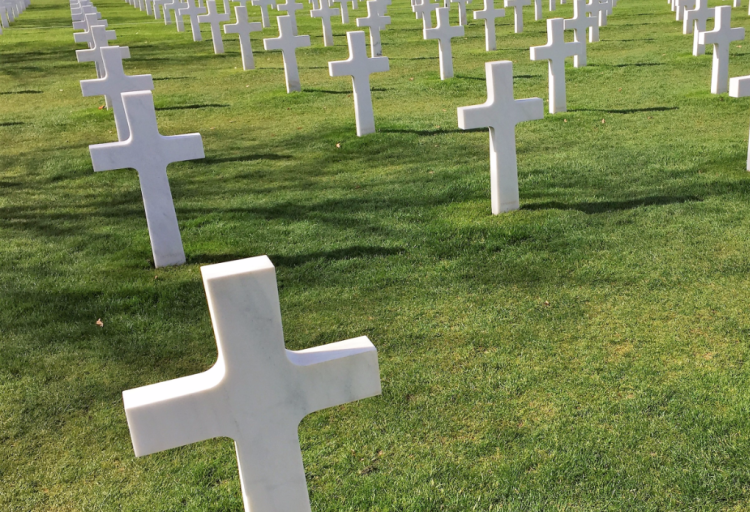
Of all the war monuments and cemeteries dedicated to North Americans, the beaches and plots at Normandy are perhaps the most haunting
Colleville-sur-Mer, Normandy, France
On an early June day in 1944, Pearl Molyneaux wondered where her boys and daughter were, as World War II charged toward deadly climaxes in Europe and in the Pacific.
As my great-grandmother wrote in her diary at home in western New York State, her son Silas, a bomber pilot, was in the Army Air Corp; son Max was in the Navy; daughter Roberta was serving in the Women’s Army Corps (WAC) somewhere in England; her oldest grandson Glenn, my father (from Oberlin, Ohio), was in the Navy, training with Marines for future amphibious landings in the Pacific; and her son Evan, an Army doctor, had left a month earlier to cross the Atlantic for Europe. Evan was headed for Normandy.
Their lives, their courage and my great-grandmother’s diary were in my thoughts when I returned to Normandy earlier this year to walk the beaches and visit the American Cemetery with a group from Uniworld’s new river vessel, Joie de Vivre.
An emotional visit to Normandy
Among the excursions on Seine River cruises that start in Paris, a day at World War II memorials on the Normandy coast is the most popular, and for many the most emotional.
At age 37, Major Evan Molyneaux would land at Normandy. He would doctor wounded soldiers in field hospitals during the next 11 months as Allied Forces fought their way across Europe, a service that earned him a bronze star.
During the 15 months of war after her diary notations in June 1944, Pearl would note her worries about whether her family would make it home. They did, all of them, by December 1945.
So many American sons and daughters did not return. Their memorials, reminders of the Normandy invasion to rescue Europe starting June 6, 1944, still send shivers to the spines of American travelers who visit the beaches and saunter quietly along the rows of white crosses and stars that mark the plots of those who were lost, including 9,387 graves at the American Cemetery overlooking Omaha Beach.
Of all the war memorials and cemeteries dedicated to North Americans, the beaches and plots at Normandy are perhaps the most haunting.
I am mesmerized by the Normandy coast, not only because of the horrendously deadly battles that occurred here as a result of a landing from the greatest armada in world history, but also because of the setting.
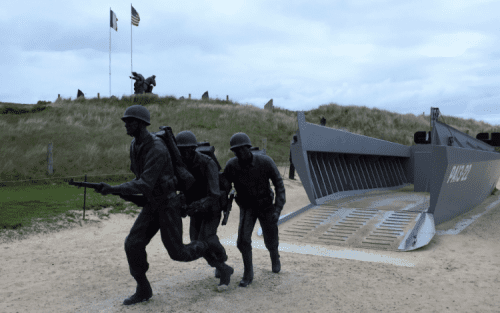
Seventy-three years later, miles and miles of nearly empty beaches carry a reverence and the kind of silence that nature seems to command at a scene of what once was a long, noisy, unnatural, human-instigated conflagration.
Sometimes in summer the sun shines, skies are blue and calmness reigns over this Atlantic edge of Normandy. But more likely, at any time of year, travelers will meet serious shades of sea and sky gray.
 On my three visits, clouds tended to sweep and swirl; winds spit and rustled the land; and reminders of mayhem still were in the air.
A space for contemplation
Most places in the world where guided tour groups congregate, by their nature as tourist sites, are scenes of noise and commotion. Finding a place to sit and contemplate often is a difficult task. Not at the Normandy memorials. For miles, up and down this haunting coast, you may sit quietly alone on a park bench, a plot of beach, or a patch of grass next to the gravestone of a brave stranger.
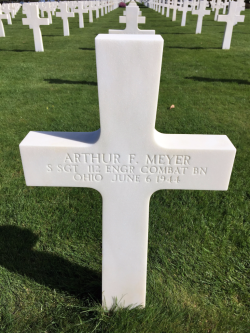
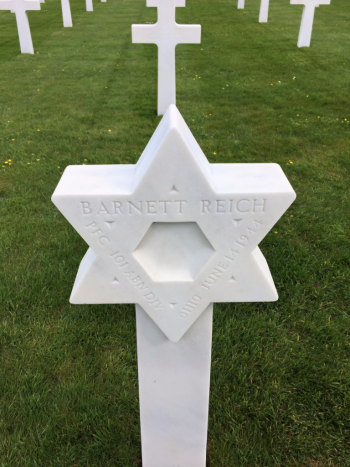
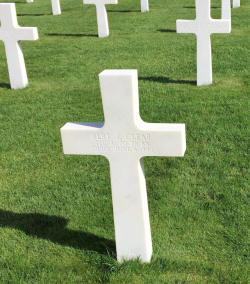
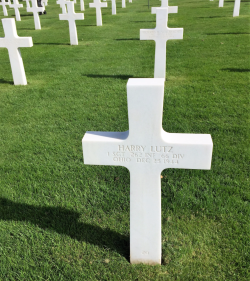
On my Normandy cemetery walk in 2017, my third, I stopped to note some fellow Ohioans:
INFORMATION
Memorials and beaches of the Normandy invasion on the Atlantic Coast of France lie about midway between Calais and the famed town and monastery of Mont Saint-Michel. Guided tours of 2-3 days may also include visits to Mont Saint-Michel and the walled city of Saint-Malo. Bus tours from Paris may be done in a day, but the drive is 3-4 hours each way. The drive time is considerably less on tours offered by Seine river cruises to ports closer to the coast.
Guided organized tours to Normandy often include a ceremony with flowers for laying on a grave and the bugle call of Taps.
The American Battle Monuments Commission operates 26 permanent American military cemeteries and 27 federal memorial, monuments and markers throughout the world.
On the Commission website, you may research the records for people buried and memorialized at American World War I and World War II overseas, military cemeteries, along with those named on the Walls of the Missing at the East Coast Memorial, West Coast Memorial, and Honolulu Memorial.
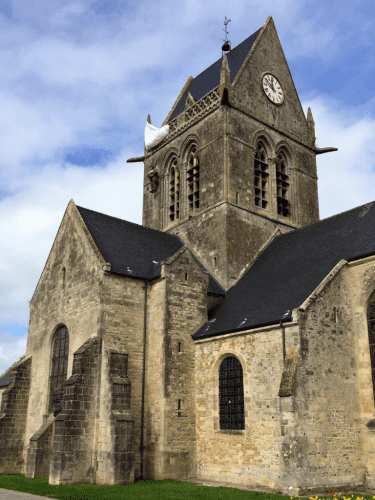
At Normandy, the American Cemetery is open to the public daily, except on December 25 and January 1, from 9 a.m. to 6 p.m. from April 15 to September 15, and 9 a.m. to 5 p.m. the rest of the year. When open, staff members in the visitor center (with restrooms) will answer questions and, with a reservation, escort relatives to graves and memorial sites.
Photos by David G. Molyneaux, TheTravelMavens.com
David Molyneaux writes regularly about cruising news, tips and trends at TravelMavenBlog.com. His cruise trends column is published in U.S. newspapers, including the Miami Herald, Dallas Morning News, and on Internet sites, including AllThingsCruise. He is editor of TheTravelMavens.com


